As part of the Repository Stream at the Gregynog Colloquium we held a discussion session on the hurdles faced by Repository Administrators when trying to encourage academic buy-in to their systems. These have been listed below and grouped into topics.
As part of the discussions we also suggested solutions for each of the obstacles. These appear after each problem raised in a different colour. The solutions are by no means exhaustive and there are some gaps.
Please add comments and suggestions to the list below, and suggest advocacy ideas that have worked for you. It is hoped this exchange of ideas will aid both our WRN community and the repository community as a whole.
Perception of time and effort required
No time
Demonstrate ease of deposit. Video materials to demo deposit using academic champions. Practice reduces time. Look into automatic completion APIs for repository.
Extra admin work
Mandate. Suggest using admin staff or PhD students to help- good practice for new researchers.
Backlog of research will take too much time to enter
Offer self-deposit to relieve backlog then encourage self-deposit. Suggest using admin staff or PhD students to help.
Benefit of repository interaction
What’s in it for me?- Apathetic to the process
Education- more widespread audience; greater recognition; higher/ faster/ sustained citation rates. Demonstration of RAE impact. Use of peers as champions. Video materials?
The paper is already published- anyone who wants to read it already has
More widespread audience- publically funded research available to whole of the public beyond subscription barriers.
Takes time to see benefit
Difference between print and electronic world?
Perception of repository importance
Lack of integration with other Uni systems and processes
Top-level buy-in to push for integration/ Mandates
Repository is an archival end point
Education on benefits- use as Management Information tool
Perceived value of system through lack of dedicated staff time
Top-level buy-in to fund positions to administer repository. Use further staff network- subject liaison; research administrators- to spread load and form experts for each school/ collection.
Copyright and IPR issues
Unsure of copyright status in papers
Use of SHERPA RoMEO/ include API on repository front page
Unsure of what was signed away with publishing license
Education. Feedback from academics to publishers. UKCoRR MoU
No longer have copies of different versions
Education
Worries about plagiarism and IPR protection
No real difference between print and online world. Getting the paper out on the web and recognised as author’s work should counteract plagiarism risk. Benefits associated with citation rates and recognition should outweigh IPR risks.
Conflicts with traditional publishing
Publishing within a prestigious journal the priority
Use of OA funds to encourage OA publishing
Older research is no longer felt relevant
Evidence of older PhD work being requested for digitisation as now informs modern research.
Other issues
Collection policy confusion- what can be accepted
Have clear collection policy stated within repository site FAQ
Can the repository take different file types?
Have clear collection policy stated within repository site FAQ- the repository can store diff file types but can end users access them easily?/ Preservation.
Don’t want to make draft version publically available
Friday, June 11, 2010

Gregynog Repository Stream
The presentations delivered during the Repository Strand at this week's Gregynog Colloquium are now available online on our project website or follow the relevant links below.
The Power of the Mandate Sue Hodges, University of Salford.
Research Publishing at Swansea University Alex Roberts, Swansea University.
Research management system at the University of Glamorgan Leanne Beevers and Neil Williams, University of Glamorgan.
Developing a repository: caring, sharing and living the dream Misha Jepson, Glyndŵr University.
Encouraging author self- deposit at Cardiff University Tracey Andrews and Scott Hill, Cardiff University.
Using statistics as an advocacy tool Nicky Cashman, Aberystwyth University.
Advocacy: the theory Jackie Knowles, WRN.
Tuesday, June 8, 2010
New IR Cross Search Service launched in Ireland
RIAN is a newly launched cross-search service for content held within 7 HEI IR's in Ireland- DCU, NUIG, NUIM, TCD, UCC, UCD, UL. An outcome of a Strategic Innovations Fund project, it was sponsored by the Irish Universities Association (IUA) and funded by the Irish Higher Education Authority (HEA).
The aim of the service is 'to harvest to one portal the contents of the Institutional Repositories of the seven university libraries, in order to make Irish research material more freely accessible, and to increase the research profiles of individual researchers and their institutions.'
The aim of the service is 'to harvest to one portal the contents of the Institutional Repositories of the seven university libraries, in order to make Irish research material more freely accessible, and to increase the research profiles of individual researchers and their institutions.'
Saturday, June 5, 2010
JABULANI

Ever since the first, official, FIFA World Cup soccer ball in 1970. There’s nothing like ours; Jabulani. Meaning “let us be happy”; made in the spirit of Ubuntu. He a stud in a beshu on an Armani suit & and laced in imbatata. I love it, apparently its a “ Grip n’ Groove, exceptionally great in flight & perfect for all weather conditions. It’s got 8, new thermally, bonded 3D panels. Moulded for the sphere, perfectly round & more accurate than ever. What can we say; these are the peps of being the latest in the market.
It comes after a generation of champions. You got to have balls man!!! First of these bally stalwarts is the Buckminster, apparently the black& white, 32 panelled descendent was only visible on black & white TV. That was the Mexican World Cup in 1970.
Chile Durlast the prince who was not meant to be a king was introduced in 1974. Tango Durlast was placed in the centre field in Argentina in 1978, as candidate design for more of its kind to come.
Tango Durlast set a pattern trend for next ball; the Tango Espana in the 1982 Spanish World Cup. The first edition of water resistant ball with a rubber inlaid over the seams. The rubber unfortunately had a disadvantage. It started to wear off after a short time of kicking & it had to be always replaced during the match. Last of its kind.
In 1986 in Mexican World Cup rolled out the first polyurethane coat, Azteca. Its the synthetic ball, which was good on wet & hard places. Rain resistance was the number one priority for Adidas.
The polyurethane continued its technological journey in the balls. In 1990; in the Italian World Cup; black polyurethane foam in layered ball; Etrvsco; was introduced.
Adidas felt at home with polyurethane. In 1994 in the USA World Cup; Questra; with an enveloped layer of polystyrene foam; was kicked to the next level. Let alone being more waterproof, but this made the have more acceleration, it had softer touch to it, control & higher velocity during gaming.
Followed after 4 years was there Tricolore in the hands of a captain in the France World Cup; in 1998. It had the French red, white & blue tri- colour. It deviated from the traditional black & white patterns. Using under glass print technology; the first colored official World Cup ball had a thin layer of syntactic foam. It inspired the next era of balls.
The era evolved in its own right; by coming up with the Fevernorva in the Korea Japan 2002. Adidas pulled it off again presenting a thicker layered for more accuracy in the flight of the new ball. The patterns resembled a blade; to cut through the air. It was a real pretty boy...
After the pretty boy, there was the handsome German; the Teamgeist. It was unveiled at the 2006 German World Cup. It was all new, made for the 21st century footballers. Complete with gold & silver patterns.
Football is such a great sport, we love it in South Africa. Unlike the way football is played in Europe: here in South Africa posses prowes, flair, trickery & top class players. We feeling it! What about you?
Friday, June 4, 2010
I can tell you now that: there isn’t any time as the time now. Its the 2nd wave of the best year in South Africa after the Rugby World Cup... The FIFA World Cup is in our country from the 11 June to 11 July & its football frenzy this side of town. One of the places synonymous with Joburg is SOWETO. Starting the kick off on 6 June 2010 is the TSJS( THESIS Social Sessions, for those who are not familiar with acronym). A dope line up is full Of LOVE. Chuck D from the Deep Soweto stable will be punching them lines like there’s no tomorrow. We got Babu; a band from Cape Town, a new resident Dj who goes by the name of Springer, I’m sure he’s was knighted for a reason. Our guest dj for the evening is Hypenoid. Talking about LOVE: the “ I LOVE SOWETO” campaign is still embroiled in our love for beautiful things, the next concept is still ready for action soon. It’s an evening of great music & people.
So don’t miss if this post does not reach you in time. I don’t know where you at; if the whole world is here .Be in SA now or be square...
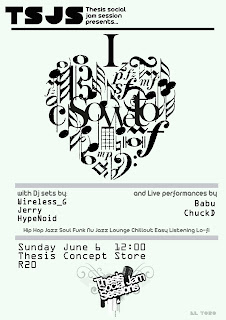


So don’t miss if this post does not reach you in time. I don’t know where you at; if the whole world is here .Be in SA now or be square...


Thursday, June 3, 2010
DSpace Add-Ons
The following are descriptions of a range of DSpace add-ons available to install which provide additional functionality to the software.
Commenting
The commenting feature brings informal communication capabilities to the DSpace environment. A threaded forum, or comments stream, can be attached to any web-page, community, collection, submitted item or e-person within DSpace. The add-on allows comments to be inserted by both anonymous users and authenticated ones while functionality for reviewing/moderating comments is also provided.
An example (in Portuguese) of comments appearing below a collection.
Compatible with DSpace 1.1 and 1.2 possibility of updating for DSpace 1.5.x
Controlled Vocabulary/Ontology
This add-on applies a subject classification system of the institutions choice to their DSpace instance. Once implemented the user chooses from the predefined taxonomy of keywords to describe items of information that are being submitted to the repository and that same taxonomy is used to find and access items held in the repository.
An example (in Portuguese) of a subject classification system in use.
Compatible with DSpace 1.1 and 1.2 possibility of updating for DSpace 1.5.x
Dublin Core Meta Toolkit
The Dublin Core Meta Toolkit gives DSpace administrators the ability to convert large amounts of information from their desktop database programs into DSpace compatible Dublin Core metadata. The toolkit provides a number of out-of-the-box database structures to ease data collection as well as enabling users to create custom converters for existing databases. The Toolkit is ideal for converting formats from Microsoft Access, MySQL and comma delimited value (CSV).
Compatible with DSpace 1.5.1
Embargo
Content submitted to a repository may be restricted by laws, policies, or contractual obligations that require the submitter not to publish or enable public access to the content for a period of time.This add-on allows DSpace administrators to build in functionality to handle embargoed items in the workflow. It allows for the metadata of the embargoed item to be indexed and viewed, but the full text of the item cannot be retrieved while the embargo is in force.
Compatible with DSpace 1.4.x, 1.5.x and 1.6
Format validator and virus check
This add-on provides rough-and-ready format checking by identifying that the file/bitstream extension matches formats verifiable by JHOVE. Currently DSpace accepts a deposit's file extension as gospel, so a user could tack a .txt extension onto a GIF and DSpace would assign the incorrect format to the file based on that incorrect extension. It also checks the file for the presence of viruses.
Compatible with DSpace 1.4.x and 1.5.x
Recommendation
This DSpace content-based recommendation feature automatically shows links to articles within the repository that a user is likely to be interested in by mapping items related to the document currently being visualized by the user. Similar to functionality seen on Amazon this feature can greatly improve user experience.
Compatible with DSpace 1.1 and 1.2 possibility of updating for DSpace 1.5.x
Request Copy
This add-on creates a semi-automated mechanism whereby would-be users can request and authors can email an individual copy of a full-text deposited within the repository whose full-text access privileges are set to restricted.
The purpose of this feature is to increase both the content deposited in an IR and its immediate usability by providing a way to accommodate the (frequently unfounded) worries of authors and their institutions about copyright infringement during any publisher embargo periods on public self-archiving.
The link is provided on all non-OA items and activates a form where the user requester must enter his/her email address and name, and may add a comment, and press a 'Request-a-copy' button. An email is sent to the depositor and the email message contains a token. Using that token, the author may reply, by just clicking in one of the two buttons available: 'Send Copy', 'Don't send copy'.
Compatible with DSpace 1.4.x and 1.5.x
Semantic Search for DSpace
Semantic Search allows intelligent search of DSpace content, using Semantic Web technologies and performs knowledge discovery on DSpace metadata. Semantic Search uses the science of meaning in language, to produce highly relevant search results.
Compatible with DSpace 1.4.2 possibility of updating for DSpace 1.5.x
Statistics
This add-on allows gathering, processing and presenting usage, content and administrative statistics from the repository. The system is based on components that can easily be configured, changed or extended, to respond to different information needs.
Compatible with DSpace 1.4.x and 1.5.x (JSPUI)
Tombstoning
The add-on allows a tombstone to be added when an item is withdrawn from the repository. The user selects from 3 reasons for withdrawing the item: 1. Removed from view by legal order; 2. Removed from view by the [authority doing removal]; 3. Removed from view at request of the author.
Compatible with DSpace 1.4.x and 1.5.x
Further details about this range of options are available here. Any WRN partner interested in discussing or investigating any of these DSpace add-ons should contact the team using the usual address wrnstaff@aber.ac.uk
Wednesday, June 2, 2010
initial rendering!

-2 1/2 weeks till' deadline for presentation of "book". this week i have to finish rendering(have ~6 figures to go) and prepare all the graphic boards. NEX WEEK IS FLATS WEEK!
today was FESTA DELLA REPUBBLICA ( an italian national holiday) and we had the day off-
so instead of resting- i slept 3 hours and headed to a friend's for a sketching part-ay!
below- see my initial figures for my fashion art project... under development :
trans-automa-sytosis


Subscribe to:
Posts (Atom)